
Are News Articles Italicized A Style Guide
Imagine you’re writing a school paper, or maybe just a quick email to a friend. You mention a movie you saw. Should you put its title in quotes or something else?
This happens with books, songs, and yes, even with news articles. Knowing these simple rules makes your writing look professional and clear. This post will answer exactly that question: are news articles italicized.
You’ll learn the correct way to present news sources in your writing, making it easier for readers to follow along and understand your references.
Key Takeaways
- News articles are generally not italicized when referred to in general text.
- Titles of shorter, standalone works are usually in quotation marks.
- Titles of longer, standalone works are typically italicized.
- Understanding these distinctions improves clarity in your writing.
- Following these style rules shows attention to detail.
When To Italicize Titles
Titles Of Larger Works
Italicizing titles is a common practice in academic and professional writing. This style helps readers distinguish between the main text and specific titles. We italicize titles of larger works.
These are works that can stand alone. Think of books, newspapers, magazines, websites, and television shows. They are complete entities.
Their titles need a distinct visual marker. This helps readers see them clearly. It separates them from the rest of the content.
Books And Longer Publications
Books are a prime example of works that require italics. When you mention a book title in your writing, you should italicize it. This applies to novels, non-fiction books, textbooks, and even lengthy reports.
For instance, if you are discussing the impact of a historical event, you might reference a book like The History of World War II. The italics clearly identify “The History of World War II” as the title of a specific book. This is a standard convention across most writing styles.
Similarly, titles of newspapers and magazines are italicized. If you read a report in The New York Times, you would refer to it as The New York Times. If you saw an article in National Geographic magazine, you would write National Geographic.
This rule applies whether you are mentioning the publication in general or referring to a specific issue. The title itself receives the italics.
Websites are also considered larger works. So, if you are citing information from a particular website, its name should be italicized. For example, you might mention that you found statistics on the National Aeronautics and Space Administration (NASA) website.
You would write it as NASA. This indicates it’s the name of the whole site.
Television Shows And Movies
Long-form media like television series and feature films also have their titles italicized. If you are writing about a popular TV show, its title should be in italics. For instance, you might discuss an episode of Stranger Things.
The series title, Stranger Things, is italicized. This differentiates it from the episode title, which would typically be in quotation marks.
The same applies to movies. If you are reviewing a film or referencing it in your writing, the movie’s title should be italicized. For example, you might say, “The film Parasite won many awards.” The italics make it obvious that Parasite is the title of a movie.
This convention helps readers quickly identify named entities within your text.
Sample Scenario: Citing Media
Let’s say you are writing an essay comparing different approaches to science communication.
- You might start by discussing a documentary series. You would write: “The documentary series Cosmos explored the wonders of the universe.”
- Then, you could mention a specific book that offers a different perspective. You would write: “In contrast, Carl Sagan’s book Pale Blue Dot offers a more philosophical view.”
- Finally, you might refer to an online resource for further reading. You would write: “Readers interested in further details can visit the European Space Agency website.”
When Not To Italicize Titles
Titles Of Shorter Works
While larger, self-contained works get italics, shorter pieces that are part of a larger whole do not. These are typically referred to using quotation marks. This distinction is crucial for clarity in writing.
It helps readers understand the relationship between the cited work and its source. For example, an individual news article is considered a shorter work.
Articles And Shorter Publications
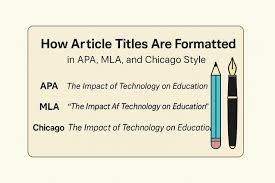
This is where the main question is answered. News articles are generally not italicized. Instead, their titles are placed in quotation marks.
Think of a news article as a chapter within a larger publication, like a newspaper or a website. It’s a component part, not a standalone entity. So, if you read an article titled “Global Leaders Meet to Discuss Climate Change” in The Guardian newspaper, you would refer to it as “Global Leaders Meet to Discuss Climate Change” in The Guardian.
The article title gets the quotes, and the newspaper title gets italics.
This rule extends to other shorter works as well. For instance, individual poems, short stories, essays, chapters within a book, and songs are usually presented with titles in quotation marks. If you are writing about the short story “The Tell-Tale Heart” by Edgar Allan Poe, you would put the title in quotes.
The book containing the story would be italicized.
Importance Of Quotation Marks
Using quotation marks for titles of shorter works serves a vital purpose. It visually separates these titles from the surrounding text. It also signals to the reader that this is a specific piece within a larger publication.
This aids comprehension, especially when discussing multiple sources or works within a single piece of writing. For example, when citing a journal article, the article title would be in quotes, while the journal name would be italicized.
The convention of using quotation marks for shorter works is widely adopted. It is consistent across major style guides like the APA (American Psychological Association) and MLA (Modern Language Association). Adhering to these guidelines ensures your writing is professional and easily understood by your audience.
It prevents confusion between different types of written or published material.
Sample Scenario: Citing News
Imagine you are writing a report on recent economic trends.
- You might cite an article from a financial newspaper. You would write: “An article titled ‘Inflation Fears Ease Slightly’ in The Wall Street Journal offered some optimism.”
- You could also mention an online news report. You would write: “On the BBC News website, the report ‘New Trade Deal Announced’ detailed the agreement.”
- If discussing expert opinions, you might reference a specific opinion piece. You would write: “The op-ed ‘Economic Policy Rethink Needed’ published in The Economist provided a critical analysis.”
APA And MLA Style Guidelines
APA Style For News Articles
The American Psychological Association (APA) style is commonly used in social sciences and education. In APA style, the general rule for citing news articles is straightforward. The title of a news article itself is not italicized.
Instead, it is enclosed in quotation marks. This applies to articles found in newspapers, magazines, and online news sources. The name of the newspaper or magazine, if mentioned as the source, is usually italicized.
For example, if you are referencing an article from The Washington Post, you would write: “Reports Indicate Steady Job Growth” in The Washington Post. Here, “Reports Indicate Steady Job Growth” is the article title in quotation marks, and The Washington Post is italicized as the name of the publication. This clear distinction helps readers locate the source material easily.
When creating a reference list in APA, the article title is presented in sentence case and quotation marks. The publication title follows, italicized. This consistency ensures that all references are formatted uniformly, making your bibliography easy to read and navigate.
APA Example
Here is a common way to refer to a news article in APA style within the text:
According to the article “Scientists Discover New Exoplanet” in The New York Times, the discovery could revolutionize astronomy.
In the reference list, it would look something like this:
Author, A. A. (Year, Month Day).
Scientists discover new exoplanet. The New York Times. https://www.nytimes.com/example
MLA Style For News Articles
The Modern Language Association (MLA) style is frequently used in humanities disciplines like literature and languages. MLA style also follows the convention of not italicizing news article titles. Instead, article titles are placed within quotation marks.
The title of the publication (newspaper, magazine, or website) where the article appears is italicized.
For instance, if you are citing an article from The Atlantic magazine, you would write: “The Future of Artificial Intelligence” in The Atlantic. The article title is in quotes, and The Atlantic is italicized as the magazine’s name. This rule holds true whether you are discussing a print version or an online article from the same publication.
In MLA citations, the article title is capitalized using title case and enclosed in quotation marks. The publication title follows, italicized, along with relevant publication details such as the date and page numbers or URL. This adherence to MLA formatting is essential for academic integrity and clear communication.
MLA Example
Here is how you might cite a news article in MLA style within your text:
The article “Debate Continues Over Renewable Energy Policies” in The Guardian presented various viewpoints.
A corresponding entry in your Works Cited page would appear similar to this:
Author, A. B. “Debate Continues Over Renewable Energy Policies.” The Guardian, 15 May 2023, www.theguardian.com/example.
Accessed 20 Oct. 2023.
Common Myths Debunked
Myth 1: All Titles Should Be Italicized
This is a common misunderstanding. While many titles do get italicized, it’s not a universal rule for all types of works. The key distinction lies in whether the work is a standalone publication or a part of a larger publication.
Books, newspapers, and websites are generally considered standalone, hence italicized. Individual articles within them are not.
Myth 2: News Articles Are Italicized When Referencing A Specific Report
This is incorrect. As established, when you are specifically referring to the title of a news article, it should be placed in quotation marks, not italics. The italics are reserved for the publication itself (the newspaper, magazine, or website) if you are mentioning it by name.
Myth 3: Quotation Marks Mean Less Importance Than Italics
The choice between quotation marks and italics is not about importance but about categorization. Both are important stylistic conventions. Quotation marks are used for shorter, often contained works that are part of a larger whole.
Italics are used for larger, complete works. Neither signifies greater or lesser importance.
Myth 4: You Can Mix And Match Styles Freely
Consistency is key in writing. While different style guides exist, you should choose one (like APA or MLA) and stick to its rules throughout your document. Randomly switching between italicizing and quoting titles for similar types of works will confuse your readers and undermine your credibility.
Frequently Asked Questions
Question: Are online news articles italicized
Answer: No, the titles of online news articles are typically put in quotation marks, not italicized. The name of the website or online publication might be italicized.
Question: Should a newspaper title be italicized
Answer: Yes, the title of a newspaper itself, like The New York Times or The Wall Street Journal, should be italicized.
Question: How do I cite a news report in a blog post
Answer: In a blog post, you would generally follow standard citation rules. The title of the news report would be in quotation marks, and if you mention the blog’s name, it might be italicized.
Question: What about magazine articles
Answer: Similar to news articles, individual magazine article titles are placed in quotation marks. The magazine’s title, however, is italicized.
Question: Is there a difference for academic papers
Answer: Academic papers often follow specific style guides like APA or MLA, which dictate these rules. Generally, these guides require article titles in quotes and publication titles in italics.
Conclusion
News articles are not italicized. Their titles are placed in quotation marks. Larger works like newspapers and websites get italics.
This simple rule makes your writing clear and professional. Always use quotes for article titles and italics for the publication. This helps readers easily find and identify your sources.

Related Posts
Identifying Left and Right News Outlets
Seeking Unbiased News Sources In A Complex World